Refrigerator System Overview
This document gives an overview about the refrigerators with motor compressor, noting that there are two types of refrigerators:
Motor compressor refrigerators - mostly used in households, bigger, more expensive, more efficient.
Peltier refrigerators - mostly used in camping devices as they are smaller and cheaper.
The two dominant refrigeration technologies differ fundamentally in how they move heat. A motor compressor system uses the vapor-compression cycle: an electric motor drives a compressor that circulates a refrigerant, which absorbs heat inside the cabinet and releases it outside as it changes between liquid and gas phases. A Peltier (thermoelectric) system has no moving parts and no refrigerant; it relies on the Peltier effect, where passing a DC current through a junction of two different semiconductors causes one side to absorb heat and the other to release it.
In practical terms, motor compressors are far more efficient and can reach much lower temperatures, making them the standard for household and commercial refrigerators, but they are noisier, heavier, and contain moving parts that can wear out. Peltier coolers are silent, compact, lightweight, and vibration-free, but they are energy-inefficient and typically only cool to around 15–20 °C below ambient, so they suit small portable coolers, mini-fridges, and electronics rather than full-size appliances.
How a motor compressor refrigerator works
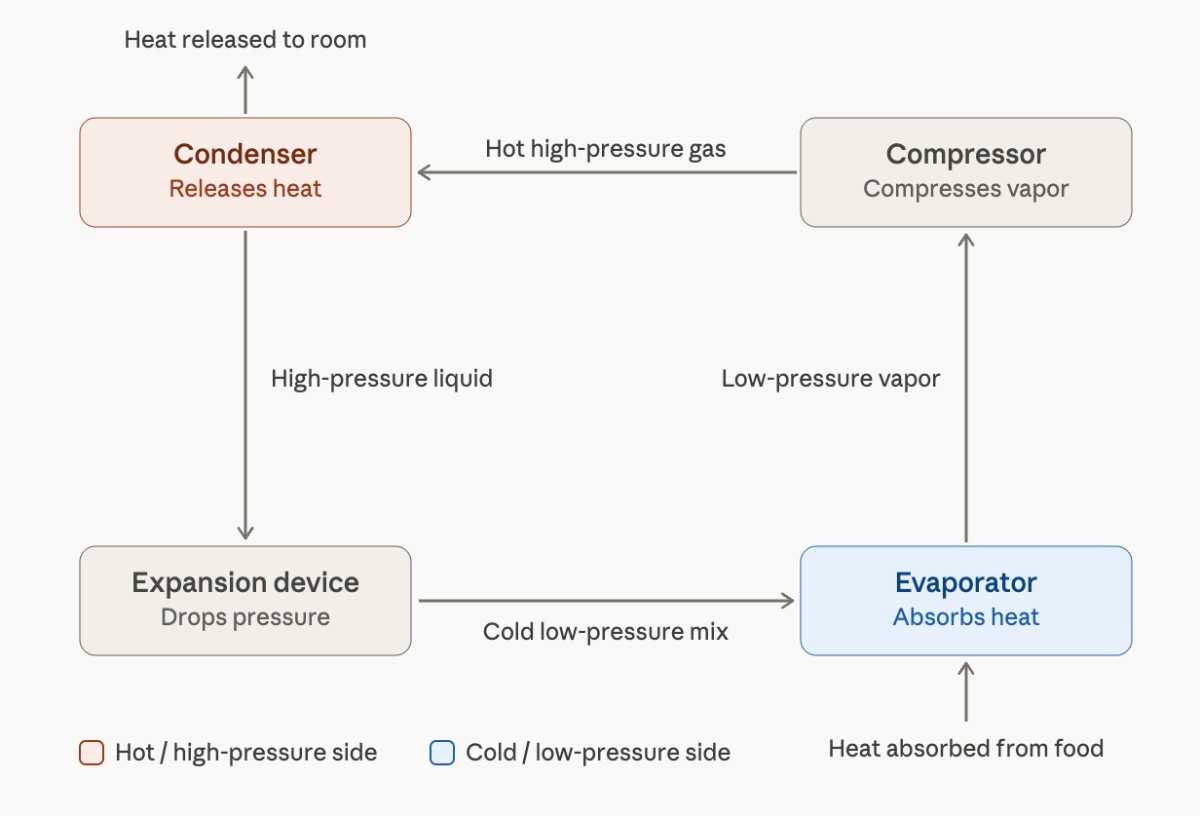
A motor compressor refrigerator operates on a closed-loop vapor-compression cycle that continuously moves heat from inside the cabinet to the surrounding room. The refrigerant circulates through four main stages:
The compressor draws in low-pressure refrigerant vapor from the evaporator and compresses it, raising its pressure and temperature. This hot, high-pressure gas then flows into the condenser, where it gives up heat to the room air and condenses into a high-pressure liquid. The liquid passes through an expansion device, which abruptly drops its pressure, causing it to cool sharply and partially flash into vapor. This cold mixture enters the evaporator inside the cabinet, where it absorbs heat from the food and interior air, boiling into a low-pressure vapor. The vapor returns to the compressor, and the cycle repeats.
System components
The core and supporting components of such a system are:
Compressor — the heart of the system; an electric motor drives a pump (usually reciprocating or rotary) that compresses the refrigerant vapor and circulates it through the loop.
Condenser — a coil of tubing (typically on the back or underside) that releases the absorbed heat to the surrounding air, condensing the refrigerant from gas to liquid.
Expansion device — a capillary tube or thermostatic expansion valve that throttles the high-pressure liquid, dropping its pressure and temperature before it enters the evaporator.
Evaporator — the coil inside the cabinet where the cold refrigerant absorbs heat from the interior, cooling the food compartment.
Refrigerant — the working fluid (e.g., R-600a isobutane, R-134a) that carries heat as it cycles between liquid and gas states.
Filter/drier — removes moisture and contaminants from the refrigerant to prevent blockages and corrosion.
Thermostat / control unit — senses cabinet temperature and switches the compressor on and off to maintain the set point.
Fans — circulate air over the evaporator and condenser coils (in frost-free and many modern units) to improve heat exchange.
Accumulator / suction line — protects the compressor by ensuring only vapor (not liquid refrigerant) returns to it.
Comments
Sign in to join the conversation
Sign InNo comments yet. Be the first to share your thoughts!